Sadly, the critics were right. What starts out as a fun, breezy and occasionally poignant story -- two grifter brothers (Mark Ruffalo and Adrien Brody) and their near-silent accomplice (Rinko Kikuchi) who attempt a multi-continent con on an eccentric heiress (Rachel Weisz) -- gradually takes on larger themes as the con gets bigger and the film gets longer. In the end, it goes pretty much where you think it'll go, it takes too long to get there, and the message is delivered with a heavy hand.
One additional complaint on con movies: The plots tend to be too big or too intricate or too both. There's nothing wrong with a simple ruse -- fewer holes can be punched, making for a film that doesn't leave you going, "Hey, wait a second ..."
One compliment on Brothers (aside from the performances, which are -- unsurprisingly -- quite good): Johnson knows how to create him some images. Lets hope he gets his hand on a script* that lets him show his knack for aesthetics within the confines of an equally great story.
... feel-good, because it's a fun comedy with quirky characters and a happy message; feel-only-kinda good because of the horrific fate of writer-director-star Adrienne Shelly, which need no snarky comment because it was simply horrible.
Still, that doesn't make the movie itself off-limits, especially with all the superlatives thrown its direction back in oh-seven.
***Spoilers abound below***
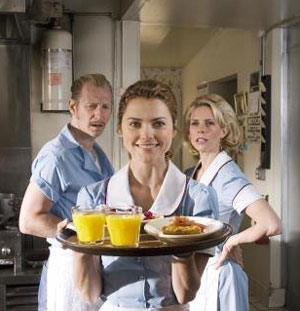
As fun as Waitress can be -- and it is quite funny, quite often -- the movie at its core is one gigantic cliche. A wayward, pregnant Southern waitress with a knack for baking pies (Keri Russell) is married to an overbearing jackass (Jeremy Sisto) and helped only by her quirky waitress friends (Cheryl Hines and Shelly, whose performance is as great as her storyline isn't) ... until a Northern doctor (Nathan Fillion) shows up and sweeps Russell off her feet. Sort of.
Sort of, since she *doesn't* end up with the doctor. Why? Because nearly all the male characters in this movie are idiots. Sisto is a jerk. Fillion is a dope. Even the Shelly character's love interest (Eddie Jemison), cute as he might be, also is pretty dim. Well, OK, they saved room for the Sage Old Man character (Andy Griffith, who else?) ... because all old people are smart, of course, and you're not smart until you get old, right*? But the point is, in a great swoop of Girl Power, Russell decides that, well, that Fillion's character is a dope.
*But, when you're old, of course you must die during the movie to illicit sympathy from the audience. That's as American Movie Formula as apple pie (and all the other pies served in this movie)**.
**Another reason why I didn't get caught up in the Waitress frenzy: I'm a health food absolutist and thus don't eat pie. So the whole mouthwatering delight thing was lost on me.
Anyway, yes, Waitress sidesteps the she-finds-love-with-another-man cliche. But it replaces it with another: The happily-ever-after-with-me-and-my-baby cliche. You see, Russell's character *hates* this baby throughout the movie, because it's her husband's, it's making her fat, etc. Of course, this is true until the baby gets born*. Then she realizes how beautiful it is and how complete her life is and blah, blah, blah.
*And, while I'm at it, why do movies always show the obligatory birth scene? They might not all be as graphic as Knocked Up's, but they're just as gratuitous.
But the mother-loving-baby thing isn't the bad part here. It's the fact that mother loving baby = everything will be wonderful until the end of time! (This wondefulness factor goes for all the sympathetic characters in the script, BTW. They all win. Except the dead guy, but he was old, so that's OK. He's probably in heaven anyway -- the eternal version of happily-ever-after.)
But here's the thing: No matter how happy you get, sometimes life just sucks. The happily-ever-after thing is pure nonsense. There's nothing wrong with things ending positively, but good God -- at least show her struggling with her taxes or something! Maybe stubbing a toe? Her favorite singer losing on American Idol? Something!
It's disgustingly ironic how Shelly's life ended, when you consider the way her final film did. I *will not* say it proves my point, because it doesn't -- otherwise, every character would die before the credits roll. And that would be ridiculous.
But so is the happily-ever-after concept. It must be stopped, lest our intelligences be insulted again ... and again .. and again ...
It's not that this story -- an Irish busker's (Glen Hansard, of something called The Frames) slight romance with a Czech immigrant/pianist (Markéta Irglová, also a musician), with a side dish of Hansard's character trying to complete an album -- totally sucks. It has nice moments and insights, especially is it pertains to the sheer incomprehensibility of some women's actions*.
*And yes, most men are incomprehensible, too ... but I'm a dude myself, so my actions make sense, dammit!
But that doesn't make the movie any good. Mostly because it's boring. Mostly because, as a "modern musical," there's way too much music here -- I'd say about half of the film's 85 minutes are wordless except for guitar strums and sung notes.
Not that music being prevalent in film is a bad thing (see: Chicago). It's just this music really isn't any good (the Oscar for Best Song notwithstanding). It's not horrible, per se -- I'd hate to see the modern-day country music version of this -- but it's simply simple. As an unabashed music snob, I must again and again point out to all who will listen that "arty" music often is completely the opposite. I play the guitar about as well as I can weld, but give me a six-string and about a month of practice and I could be just as good Once's protag. I mean that. An open chord ain't exactly a John Petrucci solo.
Which also lends another element to my overall dislike of this movie: I can't get all that wrapped up in a guy's journey when I'm sitting there screaming: "You think this is hard?! Try changing tempos once in a while! Mix in a few other time signatures, why don't you?! And for the love of God, why do all you people hate drummers so much?!"
It's not totally the point, of course, which saves this movie a little. As mentioned before, the musician's relationship with Irglova's character -- she's got a husband somewhere, so their romance doesn't really take off -- is intriguing and realistic, but that story is so buried beneath melancholy, repetitive tones, it's pretty much forgettable.
I guess it's a good thing I didn't see the film until now. Guess it's obvious I won't be seeing it again. The title of this post says it all: Once is enough.
OK, so "unintentional" isn't exactly the right word, but here's what I mean: Say you're making a comedy. Not one of those intellectual Annie Hall comedies or dark Coen Bros. comedies, either. I'm talking Will Ferrell-esque. So you're making a comedy, and you set yourself up with a pretty ridiculous premise that, essentially, is little more than a backdrop for funny lines/situations/actions of hilarious actors/etc.
Now, if you're making a good comedy, you realize this. Sure, you might complete the plot, but you know the audience doesn't care if Ron Burgundy covers the big story, or if Miles Monroe assassinates The Leader('s nose), or if Billy graduates and inherits the Madison hotel fortune. They're there for funny. Period. As some guy once said, make 'em laugh.
So you treat the plot as such. It's just kinda there.
But if you're making a lesser comedy, you get the silly notion that your story actually matters.
Like in Semi-Pro, which I finally saw recently, prompting this whole rant.
Semi-Pro shoulda been called Semi-Good (ho ho ho), because its opening third is hilarious. Just hilarious*.
*Best line, on whether a guy who sat on the bench for an NBA-championship team deserves credit for winning a title: "I mean, if you watch a porn movie, doesn't mean you got laid."
Yes, some ... films ... can fit a terrific plot with loads of laughs. But others seem destined for comedy-and-nothing-else glory, yet can't let go of the story. And if you're like me, you're standing up in the theater/your living room, throwing junk at the screen and screaming, "Why'd you take my funny away?!"
Some other offenders:
-Wedding Crashers: Maybe the absolute worst, just for how sickeningly schmaltzy it gets near the end. The final wedding scene is just gag-worthy. Ugh. I get mad even thinking about it.
-Old School: Needed more, um, "wrestling," and less "will they save their frat and show up a pre-AriJeremy Piven?"
-Knocked Up: Yes, I know Judd Apatow likes to say things in his movies, but the whole third-act "I'm gonna get my life together" turn is pure comedy killer. Plus, the ending itself is just eye-rollingly unreasonable. Here's hoping Funny People doesn't fall for the same things as it goes for "comedy with MEANING."
... and now for something completely different, the all-time greatest example of a comedy that just doesn't care about its plot and isn't afraid to let you know it:
As a wise man once said, you gotta use your instincts.
I did, when skipping Ratatouille during its theater run -- despite copious accolades and strong reviews. And I used them again, when resisting the temptation to ... well ... to make any effort whatsoever to see it.
Until recently. Oops*.
*Blame cable.
Here's the point: Pixar's 2007 Oscar-winning film about a rat who happens to be a chef ... it's just not good. Sorry.
I know, I know ... I'm in the vast minority on this one.
And maybe it's because I couldn't care less about the culinary arts*.
*Personal note: I eat the same things, almost, every day. It's just what I do.
Or maybe it's because I have an extreme dislike for Patton Oswalt, who took time off from his smug stand-up "comedy" act to voice Remy, our hero.
Then again, anti-actor sentiment hasn't kept me from liking films before (and the appearance of two favorites, Will Arnett and Ian Holm, should offset it here anyway). As for the anti-food bias -- Sideways' massive crush on wine (another thing I care zero about) couldn't keep that movie from being great, IMO.
So no, there's something else at work with Ratatouille. Really, it's just that everything about the film is so ... obvious. The dialogue*, the plot, the chase scenes (yawn), even the names of some characters**. It's a film that thinks it's being creative by sticking a rat in a fancy restaurant, but in the execution it manages to render even its original ideas ordinary. Plus, the animation isn't even that great.
*The stuff that's comprehensible, anyway -- because, honestly, I couldn't understand a one word Janeane Garofalo's character says.
**A would-be chef named Linguini? An arrogant guy named Ego? How clever!
It seems to be a problem with American animated films, and possibly the Pixar label itself. For some reason, the standards of excellence are just a notch lower. That's likely how Ratatouille became be almost universally loved -- it was on even more top 10 lists than Michael Clayton, for God's sake -- despite its unending mediocrity. It happened to The Incredibles, too -- a largely OK movie that somehow got labeled great.
And while I'm at it, that might be what happened to Wall-E. Its setup -- the first 45 minutes or so -- is the stuff of pure wonderment. In fact, the Wall-E/Eve love story never lets up, staying fresh and adorable until the end. Except there's this little subplot ... with humans ... and saving the Earth ... and even two human characters who strike up their own relationship ... blah. And that's just the kind of blah that keeps a lot of American animation down.
Ah, well. At least Wall-E had some stuff going for it, unlike its immediate Pixar predecessor.
This: It doesn't work. Not in terms of, like, making good movies. Sure, everyone does bad ones. But when they hire Vin Diesel for the Fast and the Furious remake (now with ampersand; articles not included), you go: "Yeah, sounds about right." Cage, though -- he just fits badly in bad movies. And it's not like this idea is new. It's been going on since at least, like, 1997*.
*Con Air actually owns, despite Cage's awful accent. "Or as they say in Ebonics, 'We be f*****.'"
Now, we could further rail on Cage, complaining about why the actor makes such choices. But that would be like badgering baseball players for saying "yes" to the multimillion-dollar contracts offered by billionaire owners. Nope, not gonna happen. Not here.
Instead, we'll just offer yet another string of "whywhywhy?" -- as in, why does Cage keep getting these roles? It hurts to watch. Mostly it hurts because there's a place (there's a place) where Cage can go (where Cage can go) to find perfect roles for his persona.
Cage did, in fact, flat-out nail the lead roles in three of The Film Official's all-time favorites:
Next question: Was 2001: A Space Odyssey one of the most influential films of its time (1968)? Yes.
OK, another one: Is 2001 filled with pretty cool effects, sounds and images, even by today's standards? Absolutely. (Click here for an example, but beware spoilers.)
Still ... Is 2001 a slow, mostly empty experience whose story only makes moderate sense (unless you happened to burn one with The Dude before watching it)? That one, too, is affirmative.
Sorry to go after an Unquestionable Legendary Film, but seriously -- sure, the cinematic tricks are fun (the opening bit about the Dawn of Man, in particular, still is a wow*). But a truly great film, in and of itself, these things do not make. That's why the word "influential" is thrown around. Here, it's a euphamism for, "Way original, and good for it's time, but ..."
I should have known I was going to dislike this movie* when the main character quoted Notorius B.I.G. in the opening minute.
*And yes, I realize I'm years late to the Boiler Room party. I also haven't seen Scarface. What are my qualifications again?
Nothing against, uh, Notorius? Mr. B.I.G.? Whatever. But yeah, nothing against the late hip-hop artist. It's just that the main character (played by Giovanni Ribisi) is whiter than a rural Kansas high school ... and when he quotes rap lyrics, he does it with zero irony* (unlike, say, Michael Bolton in Office Space).
*Not that music taste should be segregated by race or upbringing -- based on my own background I probably should be listening to Bob Dylan and The Beatles instead of Pantera and Every Time I Die -- but there's just something phony about a lame white dude reciting Biggie like the two used to sling rocks together back in Brooklyn.
That lack of irony -- that's the initial problem with Boiler Room, one of those oh-so-cool movies that ends up on a lot of college-age guys' best lists (often alongside Boondock Saints and other junk like that). It's easy to see why -- it's a macho white boy's wet dream of a film, a yarn about a New York kid whose tough upbringing (his father has quite the unenviable job -- he's a judge) leads him to drop out of school and run a casino out of his basement until he meets some young punk stock brokers (with almost zero appeal to anyone who ever tore a paper towel in half or drove a hatchback) and gets swept into their world.
Oh, but wait! It's not like they actually promote this sort of thing completely, right? Sure, being a tough talker is fine. The money, the cars -- noble pursuits, unless you're doing something wrong to get them (and -- wouldn't ya know it -- Ribisi's new brokerage firm is).
So yes, late in the movie -- long after we've seen the boss vs. boss conflict, the boss + Ribisi + love interest triangle, and of course the Ribisi vs. father struggle (yawn, yawn and, yes, yawn) -- everything gets redeemed by, what else, a Big Moral Question. Does Ribisi stay on the dark side or choose good? Does the Bad Guy get his in the end? Do father and son finally make up? And will that buyer Ribisi screwed over get a chance to make his money back?
Gee. I wonder.
It's odd, the movies that catch the college/young guy crowd. The Big Lebowski -- The Film Official's personal favorite film of all time -- is on that list. A lot of other tremendous comedies, too. Reservoir Dogs. Lock, Stock and Two Smoking Barrels. Great stuff like that.
After (finally) seeing Boiler Room, I guess even college kids can't be smart all the time.
The Scanners referred to (at the 0:40 mark) is a 1981 movie by twisteed Canadian genius David Cronenberg. Although he's become a little more mainstream lately (Eastern Promises and A History of Violence), his early filmography might be the strangest collection of above-ground films. Seriously, name a director who did stranger things than:
-Videodrome: My personal favorite from Cronenberg -- this is about a local-access TV producer (James Woods) who gets his hands on a videotape with mind-control powers. In it, Woods' character sexually stimulates a TV. It looks as weird as it sounds.
-The Fly: Haven't seen it, but Jeff Goldblum becomes half-man, half-fly after a teleportation mishap.
-Crash: No, not the Best Picture winner (ugh) from a couple of years ago. This deals with people who are aroused by car crashes. Like, literally aroused.
-eXistenZ: Is it a video game? Real life? A mix of the two? And why is there a gun made out of animal bones?
-Spider: It's like Oedipus Rex, only set in London, with the main character (Ralph Fiennes) also happening to be pretty much insane.
-Naked Lunch: Based on a book; about a guy (Peter Weller) who gets hooked on insecticide and sees giant cockroaches.
And...
-Scanners: Which is most famous for that scene mentioned in Wayne's World. And it's not hard to see why. Seriously, a guy's head explodes. If you want, click here to see it (it's not as graphic as, say, Hostel, but it's still not even remotely safe for work).
Honestly, there's a reason that's scene is about all the movie is remembered for. It features mostly low-level acting (although bad guy Michael Ironside went on to have quite the TV/film career playing odd and/or tough characters -- he was even the bad guy in Free Willy). The story, about people with telepathic powers trying to take over the world (and yes, they can make people's heads explode with their minds), is slightly nonsensical and pushed forward through long bits of expository dialogue that would be boring to read, let alone hear from (mostly) human characters. The ending isn't really as surprising/satisfying as it wants to be (unlike the aforementioned Videodrome, which came out just two years after Scanners but was vastly superior).
Still, this one remains memorable, for a couple of reasons. One -- yes, that head-explosion scene. If you're squeamish, you don't want to see it. But if you can take it, it's really remarkable and almost unparalleled, still. Incredibly well-done, especially for the early 1980s.
Then there's a duel much later, between Ironside's bad guy and the main character (Stephen Lack -- and there's a really easy acting joke to be made about his last name). That showdown, quite simply, is gross -- and awesome (watch it here, if you dare). Film after film pits the good guy against the bad guy in a final EPIC BATTLE FOR ALL THE WORLD. Usually it involves some lame hand-to-hand combat or a gun battle. Not this one. It doesn't get much better, or more original, than in Scanners.
Another note: The score. It's mostly electronic, like much 1980s movie music. But in a film like this -- futuristic, scientific, telepathic -- it works perfectly (unlike in, say, The Killing Fields). Even more interesting -- it's one of the first compositions by Howard Shore, the guy who went on to win three Oscars with the Lord of the Rings franchise.
Watchmen is easily the best film I've seen all year.
Yeah, so it's the first 2009 movie I've seen. So what?
Actually, so this: Watchmen might be the No. 1 out of 1, but it ain't all that good*.
*First a disclaimer: I have not read the graphic novel. Therefore, although my complaints might also pertain to the source material, that's not the point. The point is, this is a movie. If I wanted something faithful to the book, I would read the book.
We'll call it The Dark Knight, Part 2: It involves superheroes. It looks great, it sounds great, some characters are great and some lines they utter are, well, great.
But then there's the fact that it's looooooong. No, not long. Long is fine (see: Rings, Lord of the). So let's say "bulky." Needed a cut.
Of course, that probably would have angered book fanboys and fangirls, so I understand why it didn't get one. But that doesn't make it OK. Do we really need every character's back story? Two (or was it three? four?) romance plots, none of which is very interesting? The identity of a certain character's certain parent? Yawn.
And then there's the endless moralizing, which seems to be in vogue in superhero movies these days. Like The Dark Knight before it, characters spew platitudes that will probably end up on Facebook profiles or something. And yes, I know most of these characters were human, so that gives them a little more of an excuse to ... well, to be human. But there's just something odd about hearing dull philosophy from folks who otherwise specialize in kicking ass and taking names (and, in this case, placing those names on court dockets). Give me Tony Stark's unapologetic megalomania over the internal conflicts of Strong and Pretty People any day, thanks.
All of this brings me to another parallel to TDK, and this one on the positive tip -- it really does have one strong redeeming character. In the Batman movie it was Joker, who was unpredictable and manic and hilariously so. In Watchmen it's our quasi-narrator, Rorschach, a cynical little tough guy who wears a mask and speaks in gravelly, Christian Bale Batman/Walt Kowalski tones and who often omits the articles from his sentences so they spew faster. It sounds like noir narration -- the best narration of all, IMO. And really, the climax is something out of noir, too.
So why all the heft around it? Rorschach (played by Jackie Earle Haley, who couldn't be farther from Kelly Leak unless he were playing a sex offender) and his unraveling the mystery of who killed The Comedian -- that works. The rest -- all the other characters and their internal (and, sort of, external) conflicts -- leave it. In the end, it's all empty words, except for the ones Rorschach speaks. Gimme a 90-minute movie about him, and you've got yourself a hit in my eyes*.
*And yes, a legion of angry book zealots. But hey -- if they don't like it, they can go read.
OUTTAKES -Awesome opening credits. Who else thinks there should be an Oscars category for Best Title Sequence?
-As an actress, Malin Akerman is ... well, she's hot. Although she showed chops when explaining her love of Freakshow.
-Another complaint: The soundtrack. Just add Kanye and The Fray and you could upload it straight to a college kid's iPod. The Sounds of Silence? Hendrix's All Along the Watchtower? Good songs. Didn't fit. FAIL.
-End on a positive note: Always great to see Mickey from Seinfeld get work, and good work at that.
P_T_D once went to film school, but left because he found the job landscape too bleak. Now he is comfortably employed in the rock of stability known as journalism, and surely shall remain so until the end of time.
A: The Film Official is home to all of P_T_D's film-related thoughts, feelings, notions, opinions, and other synonyms that can be found on Thesaurus.com when you type in the word "thoughts."
Q: You're not just going to review movies and do nothing else, are you?
A: No, I'm also going to crack jokes about your mom.
Q: Who is P_T_D?
A: That's what your mom said.
Q: How often will The Film Official be updated?
A: Jeez, whenever I feel like it, OK? Stop hounding me all the time! You people are so needy!
 (Pic found at HitFix)


 Posts
Posts


