Showing posts with label 2007. Show all posts

Friday, May 22, 2009

Waitress

Waitress, feel-kinda-good movie of early 2007 ...

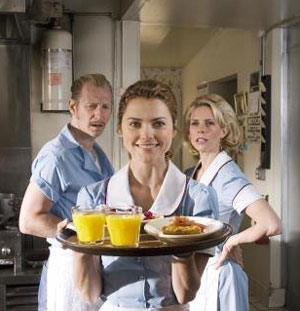
(Pic found at YumSugar.com)

... feel-good, because it's a fun comedy with quirky characters and a happy message; feel-only-kinda good because of the horrific fate of writer-director-star Adrienne Shelly, which need no snarky comment because it was simply horrible.

Still, that doesn't make the movie itself off-limits, especially with all the superlatives thrown its direction back in oh-seven.

***Spoilers abound below***

As fun as Waitress can be -- and it is quite funny, quite often -- the movie at its core is one gigantic cliche. A wayward, pregnant Southern waitress with a knack for baking pies (Keri Russell) is married to an overbearing jackass (Jeremy Sisto) and helped only by her quirky waitress friends (Cheryl Hines and Shelly, whose performance is as great as her storyline isn't) ... until a Northern doctor (Nathan Fillion) shows up and sweeps Russell off her feet. Sort of.

Sort of, since she *doesn't* end up with the doctor. Why? Because nearly all the male characters in this movie are idiots. Sisto is a jerk. Fillion is a dope. Even the Shelly character's love interest (Eddie Jemison), cute as he might be, also is pretty dim. Well, OK, they saved room for the Sage Old Man character (Andy Griffith, who else?) ... because all old people are smart, of course, and you're not smart until you get old, right*? But the point is, in a great swoop of Girl Power, Russell decides that, well, that Fillion's character is a dope.

*But, when you're old, of course you must die during the movie to illicit sympathy from the audience. That's as American Movie Formula as apple pie (and all the other pies served in this movie)**.

**Another reason why I didn't get caught up in the
Waitress frenzy: I'm a health food absolutist and thus don't eat pie. So the whole mouthwatering delight thing was lost on me.

Anyway, yes, Waitress sidesteps the she-finds-love-with-another-man cliche. But it replaces it with another: The happily-ever-after-with-me-and-my-baby cliche. You see, Russell's character *hates* this baby throughout the movie, because it's her husband's, it's making her fat, etc. Of course, this is true until the baby gets born*. Then she realizes how beautiful it is and how complete her life is and blah, blah, blah.

*And, while I'm at it, why do movies always show the obligatory birth scene? They might not all be as graphic as Knocked Up's, but they're just as gratuitous.

But the mother-loving-baby thing isn't the bad part here. It's the fact that mother loving baby = everything will be wonderful until the end of time! (This wondefulness factor goes for all the sympathetic characters in the script, BTW. They all win. Except the dead guy, but he was old, so that's OK. He's probably in heaven anyway -- the eternal version of happily-ever-after.)

But here's the thing: No matter how happy you get, sometimes life just sucks. The happily-ever-after thing is pure nonsense. There's nothing wrong with things ending positively, but good God -- at least show her struggling with her taxes or something! Maybe stubbing a toe? Her favorite singer losing on American Idol? Something!

It's disgustingly ironic how Shelly's life ended, when you consider the way her final film did. I *will not* say it proves my point, because it doesn't -- otherwise, every character would die before the credits roll. And that would be ridiculous.

But so is the happily-ever-after concept. It must be stopped, lest our intelligences be insulted again ... and again .. and again ...

Tuesday, May 12, 2009

Once is enough.

After almost two years of hearing all about what Once was about, I finally got to see what Once was all about.

(RTE Entertainment with the pic)

The verdict: A big, emphatic blah.

It's not that this story -- an Irish busker's (Glen Hansard, of something called The Frames) slight romance with a Czech immigrant/pianist (Markéta Irglová, also a musician), with a side dish of Hansard's character trying to complete an album -- totally sucks. It has nice moments and insights, especially is it pertains to the sheer incomprehensibility of some women's actions*.

*And yes, most men are incomprehensible, too ... but I'm a dude myself, so my actions make sense, dammit!

But that doesn't make the movie any good. Mostly because it's boring. Mostly because, as a "modern musical," there's way too much music here -- I'd say about half of the film's 85 minutes are wordless except for guitar strums and sung notes.

Not that music being prevalent in film is a bad thing (see: Chicago). It's just this music really isn't any good (the Oscar for Best Song notwithstanding). It's not horrible, per se -- I'd hate to see the modern-day country music version of this -- but it's simply simple. As an unabashed music snob, I must again and again point out to all who will listen that "arty" music often is completely the opposite. I play the guitar about as well as I can weld, but give me a six-string and about a month of practice and I could be just as good Once's protag. I mean that. An open chord ain't exactly a John Petrucci solo.

Which also lends another element to my overall dislike of this movie: I can't get all that wrapped up in a guy's journey when I'm sitting there screaming: "You think this is hard?! Try changing tempos once in a while! Mix in a few other time signatures, why don't you?! And for the love of God, why do all you people hate drummers so much?!"

It's not totally the point, of course, which saves this movie a little. As mentioned before, the musician's relationship with Irglova's character -- she's got a husband somewhere, so their romance doesn't really take off -- is intriguing and realistic, but that story is so buried beneath melancholy, repetitive tones, it's pretty much forgettable.

I guess it's a good thing I didn't see the film until now. Guess it's obvious I won't be seeing it again. The title of this post says it all: Once is enough.

Monday, May 11, 2009

Beautiful ...


... just beautiful* ...

*No, I'm not referring to the dude in the tub.


... did I mention beautiful?


I've dropped this movie's name enough in previous posts, so it's about time I give The Assassination of Jesse James by the Coward Robert Ford (deep breath) its what-for.

As I write this, I'm not sure Assassination is at all inferior to 2007 shoulda-been Best Picture Winner There Will Be Blood. I am sure it's superior to the one that actually won the award (more on No Country here).

Why? I posted three elements above: The gorgeous cinematography (by Roger "How the #$%& Hasn't He Won an Oscar?" Deakins), the interplay between Brad Pitt (as James) and Oscar nominee Casey Affleck (as Ford)*, and the chills-inducing score by Nick Cave and Warren Ellis (which didn't even get nominated). But those, like I said, are just elements. The whole is just as good.

*Although the rest of the cast -- especially the ever-excellent Sam Rockwell -- isn't far behind.

Strangely, I would only recommend Assassination to a select group; it was box-office poison, and for once, it's easy to see why: It's slow and long (160+ minutes), and if you don't buy the pace, you're gonna hate it. But if you're of the right mindset, there's just something hypnotizing about this story of early hero worship and celebrity (which, incidentally, is not unlike writer-director Andrew Dominik's only other, aforementioned, film, Chopper), as the aging outlaw James drifts through the downside of his train-robbing career -- with the ambitious, voice-cracking young Ford tagging along and, ultimately, doing away with his idol.

Getting euphemistic, I'll say the plot unfolds "methodically" and also episodically, but I'm not sure anything could/should have changed. Every frame seems perfectly placed, and not just aesthetically*. The dialogue, too, seems spot-on, allowing the story to advance without any sense of contrivance.

*The Film Official Challenge: How many words can I use that end in "ically"? Technically, I say four. At least in these two grafs.

The result: When Ford finally shoots James, you know absolutely why (at least in the context of the film), but without being beaten over the head with reasons. Also, you know the heroism eventually given Ford is not one found in fairy tales -- not one that will end happily, but not like the stuff of phony tragedy, either.

If the story sounds literary, that's because it is. The opening scene -- and various parts throughout -- are narrated as if being read from a book (perhaps this book). That narration is a useful tool, filling in blanks that often go untold in poor adaptations of subtext-heavy novels. In the end, everything is understood, everything is felt, everything is ... beautiful, even if tragically* so.

*Yep, another "-ically"!

Thursday, May 7, 2009

No Country to (re)visit

"When the facts change, I change my mind. What do you do, sir?"
--John Maynard Keynes

Two things: 1) Don't ask me who Keynes was. Wait ... *checking Wikipedia* ... OK, so now I know he's Tool's frontman. No, wait. I think that's this guy. I get confused sometimes.

2) There aren't really facts, here. Just a re-visitation of 2007's Best Picture winner, more than a year after seeing it for the first (and previously only) time. My impression back then: A harrowing, intense movie that seemed quite excellent ... except something always nagged at me, even as No Country for Old Men swept the Big Oscars, over the film I voted for (after swiping Tom Berenger's ballot).

At the time I thought that nagging feeling was No Country's surprisingly open-ended conclusion, or maybe the knowledge that I paid like $10 to park on South Beach in order to see the movie.

Now ...

(This perfectly sized poster found at tutor2u)

... now, it's clear: No Country is gripping, exceptionally crafted -- and almost fatally flawed.

The flaw is in the story.

It's not hard to see No Country is about far more than a Texas welder (Josh Brolin) who discovers $2 million that "belongs" to a psycho killer (Javier Bardem) who is being trailed by an almost burned-out sheriff (Tommy Lee Jones). The sheriff's opening voiceover -- never to return -- lets us know we're after something deep. Occasional life-related musings by a number of characters point to the nature of the world, of evil, of fighting it, of fighting for yourself, for others, etc. This is heavy stuff here, even without all the vicious killing (most of it done by the Oscar-winning Bardem's character).

Which is fine. Films don't always have to make big declarations, but those that do sometimes reach legendary status, as No Country apparently did.

But ...

Those Big Idea films almost always take two paths to get there: 1) They state their thesis within the framework of a believable narrative, or 2) They present the issue with a tone of surrealism or magic realism or something that very clearly says "Suspend disbelief, everyone -- we're going for a ride."

No Country does neither. It wants to be gritty and intense and to exist in this world (or at least this world, circa 1980), but eschews logic while advancing its narrative and making its point. Too many actions/events make too little sense (Example: How does every character seem to know where his target is, almost at all times?)

Really, it's more a philosophical essay than anything else. Again, that's fine -- as long as you're not masquerading as a story. Otherwise, it's all allegory and little else. For some, that might work. Obviously, it did for Oscar voters and critics.

Not for me, though. It left me wondering if Cormac McCarthy's book filled in those plot holes, explaining all those moments of wondering "But wait -- how did he ... ?" and "How could they know ... ?" and so on. It left me pining for some of the Coen Brothers' previous gems, which said a little something about life AND told near-flawless (or acceptably oddball) stories.

It left me feeling conflicted. On one hand, it's good that the Academy honored a film so wholly different from the Best Picture stereotype, something that was dark and not afraid to be cruel and viciously clever. On the other, the aforementioned There Will Be Blood was right there with No Country, just as dark and just as clever and far less flawed -- begging Oscar to pick it, but with no success in the Most Important Category.

Saturday, May 2, 2009

We (have slight control over) the Night

There are brilliant films, horrible films, and scores of others that vary in quality*. Every once in a while, though, there's one that's too flawed to be called "good," but too original/captivating/well-crafted to be dismissed simply as "bad."

*And the award for Most Profound Statement of the Day goes to ...

That last sentence certainly describes the 2007 crime (melo)drama We Own the Night.

(Photo from NJ.com)

The story isn't so great: A coke-sniffing club owner (Li'l Joaquin), whose brother (fellow quasi-musician Marky Mark) and father (Robert Duvall, who -- little-known fact -- once was in The Sugarhill Gang) happen to be pretty important NYPD cops, reluctantly becomes involved with the Russian mafia. That puts bro and dad in danger. Then tragedy happens. There's a lot of man-crying. Eva Mendes is around, too, to yell a little bit and look, well, like Eva Mendes. In all, some parts of the plot don't make a whole lot of sense.

And yet ...

First, points to Night for rarely falling into mob-movie formula. That, combined with craft, keeps it memorable. On that craft -- it's hard to take your eyes off the screen because writer-director James Gray pretty much nails the "director" part of that duo. The film features some scenes of pure originality and intensity, and makes you care even though you probably shouldn't.

One, where Li'l Joaquin's character is wired-up and inside a drug den, is accompanied by the ringing that's probably in your ears when you know you're in an absurd amount of danger. Exceptional. Another -- a chase through reeds -- is visually impressive (if not as emotionally charged as Gray probably hoped).

But the show-stealer -- and I'm hardly the first to say this -- is the car chase.

Car chases = yawn. Usually.

This car chase is incredible*.

*It's spoiler-iffic, too, but I actually watched it before I saw the whole film, and that didn't hurt things all that much. Verdict: It's worth it.

So hey, the movie might not Own, but parts do. That's certainly worth something in an era marked by one derivative movie after another.

Sunday, April 26, 2009

Score another one for 2007

Continuing my ongoing assertion that 2007 was one of the best film years ever -- if not the best ... When you look at this list and realize The Bourne Ultimatum isn't even in the top dozen or so, you know it was a good 12 months.

But my overall 2007 post will come later. This is about Bourne.

(Nice pic at DesktopNexus.com)

What's interesting about Ultimatum is it always seemed like such a yawner. The whole series did, really -- that's why I skipped the first two installments. The standard spy/CIA/government/black ops action stuff ... woo. And at its core, that's all Ultimatum is. That's why it could never be truly awesome -- straight-line actioners rarely (if ever) are, IMO. Action is just lost on me, mostly.

Still ...

Kudos to Ultimatum for not only working as a stand-alone (if you haven't seen the first two installments, it's no big deal), but also taking its premise -- brainwashed super-assassin Jason Bourne (Matt Damon*) tries to figure out who he really is and get back at the people who made him that way -- and just running with it. Not much setup or exposition. It gets right to it.

*Maaaatt Daaaamon!

It's rarely excessive in its straightforward, French Connection-type approach (although that chase through Tangiers is a bit much). Most notable, though, is its incredible craft. /Film, listing its 10 most influential films of the last 10 years, wrote this:

The Bourne Ultimatum is on the list for exemplifying and honing two different things: the ‘running man camera’ action scenes, which is now the norm; and the rapid-fire cross cutting between an alarming amount of different angles. Paul Greengrass and Christopher Rouse go down in history for finding a way to assemble a record-breaking variety of coverage in a way that is comprehensible to the audience. I would explain how it works, but it’s mighty geeky and a little bit technical.

Yes, it's an absolute clinic on film editing (speaking of geeky and technical), which is why Rouse (deservedly) won the Oscar. Also, the aforementioned Greengrass might be one of the most technically gifted directors working today*.

*More proof: United 93. If I were to make a list of the 10 greatest films -- and I mean of all-time -- that one would receive a ton of consideration.

Which is why, even if you're not an action lover, it's hard not to get something out of Ultimatum. And if you're one of those who eats up action films like I love comedy and horror, then -- well, then you've probably already seen Ultimatum like 100 times by now and are pre-purchasing tickets for Bourne No. 4.

And who could blame you?

Monday, April 6, 2009

The Saddest Ending in the World

***Another spoiler-riffic post here -- but hey, at least this one says nice things!***

Really, it's because I can't get over just how sad this is. It's the last 3 1/2 minutes of the incredible 2007 film The Assassination of Jesse James by the Coward Robert Ford (Brad Pitt and Casey Affleck in the title roles, respectively), and it doesn't so much make you cry as it just flat-out rips at you.

There have been a lot of downer endings, of course. Some of them are poignant and appropriate, some of them excessive and almost groan-inducing. This one's of the former category, only as if it's on some sort of slow-release PED.

Please, do not watch unless you've seen the movie. And even if you have ... it's still tough to take. In a good way.

Saturday, April 4, 2009

Conspiracy (movie) theories

Everyone loves a good list*. Thankfully, our friends over at Rotten Tomatoes -- in anticipation of the new something-is-up-with-the-government flick (and probable yawner) State of Play; trailer here, if you must -- recently revealed one:

*As opposed to a bad list, like this one.

The 25 best conspiracy movies ever.

A note, before we break it down: The list is formula-based (percentage of critics who approve, average rating, etc.), so it's not decided by a committee. Therefore, films like JFK -- easily among the best -- missed out, because they didn't get unanimous raves*.

*The ones who didn't like Oliver Stone's masterpiece probably were in on the whole thing!

Thoughts ...

-Glad they recognized Blow Out (#24), a forgotten part of the John Travolta arsenal. An idea: Let's just think about this 1981 flick -- in which a B-movie sound designer stumbles upon a plot against a Presidential candidate -- when this nonsense comes out later in '09.

-Hot Fuzz (#20) is the only comedy on the list. What, did the plan to overthrow San Marcos' new leader not count?


-Seeing Minority Report (#19) on here just makes me angry. It still is the worst case of ending FAIL I can remember. What a way to blow an incredible setup.


-Finally caught The Bourne Ultimatum (#15) the other day, and it was pretty good. Can't say the same about Gone Baby Gone (#13), which had some strong moments and a confounding moral question at its center ... but overall felt a little hackneyed.

-Between Touch of Evil (#14) and Manchurian Candidate (#6), I'll take the one that was directed by the Wilt Chamberlain of filmmaking.


-L.A. Confidential (#4) is a little bit overrated. No Way Out (#8) is not.

-Speaking of overrated, I can't quite get the unconditional love for North by Northwest (#2). It has some great moments and a helluva score, but its plot registers high on the Convoluted Scale.

-Chinatown is No. 1, and no dispute with that. But two others are right up there: The Insider (#11) and The Conversation (#7) -- which just might be Francis Ford Coppola's best*.

*Yes, better than that overrated mob movie he made.


Omissions (other than Woody Allen's aforementioned Latin American satire, of course):

-JFK: Duh.

-The Alien series: It's not just a rabid, acid-blooded killer they're fighting ...

-The Usual Suspects: Or was it a conspiracy?

-The Parallax View: Like The Conversation, pure 1970s minimalism. Wow.


Huh? Exactly ...

Thursday, April 2, 2009

The duplex called Grindhouse

Yeah, we ... know ... about ... the ... trailers*.

*NSFW! None of them!

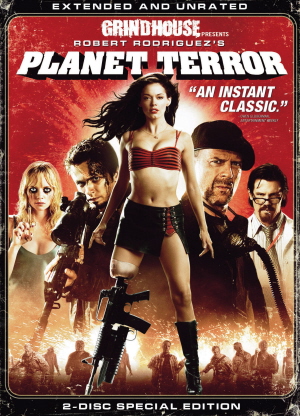
But thanks to the Encore movie package, the two feature-length segments of the Robert Rodriguez/Quentin Tarantino tag-team's 2007 offering, Grindhouse, have been circulating a bit, too.

Here are a few reasons why the first chapter, Planet Terror, is awesome:


-Rose. Mc. Gowan.

-The cord that's just a liiiiiittle too short.

-You'll shoot your eye out.

-"I must have passed out after I killed those things."

-MISSING REEL

-"Break a leg."

-The under-the-radar helicopter ride.

-And many, many more.

...

Now, here are the reasons why Death Proof is great:


Wait -- Death Proof is not great. And even if it had the chance to be, you couldn't hear me explain it because the characters won't ... stop ... TALKING!

So here's some belated praise to the powers-that-be for dividing these two after the film's unsuccessful theater run. (And, while we're at it, for not getting too finicky about all those trailers being on YouTube.)

Friday, March 27, 2009

I smell a rat

As a wise man once said, you gotta use your instincts.


I did, when skipping Ratatouille during its theater run -- despite copious accolades and strong reviews. And I used them again, when resisting the temptation to ... well ... to make any effort whatsoever to see it.

Until recently. Oops*.

*Blame cable.

Here's the point: Pixar's 2007 Oscar-winning film about a rat who happens to be a chef ... it's just not good. Sorry.

I know, I know ... I'm in the vast minority on this one.

And maybe it's because I couldn't care less about the culinary arts*.

*Personal note: I eat the same things, almost, every day. It's just what I do.

Or maybe it's because I have an extreme dislike for Patton Oswalt, who took time off from his smug stand-up "comedy" act to voice Remy, our hero.

Then again, anti-actor sentiment hasn't kept me from liking films before (and the appearance of two favorites, Will Arnett and Ian Holm, should offset it here anyway). As for the anti-food bias -- Sideways' massive crush on wine (another thing I care zero about) couldn't keep that movie from being great, IMO.

So no, there's something else at work with Ratatouille. Really, it's just that everything about the film is so ... obvious. The dialogue*, the plot, the chase scenes (yawn), even the names of some characters**. It's a film that thinks it's being creative by sticking a rat in a fancy restaurant, but in the execution it manages to render even its original ideas ordinary. Plus, the animation isn't even that great.

*The stuff that's comprehensible, anyway -- because, honestly, I couldn't understand a one word Janeane Garofalo's character says.

**A would-be chef named Linguini? An arrogant guy named Ego? How clever!

It seems to be a problem with American animated films, and possibly the Pixar label itself. For some reason, the standards of excellence are just a notch lower. That's likely how Ratatouille became be almost universally loved -- it was on even more top 10 lists than Michael Clayton, for God's sake -- despite its unending mediocrity. It happened to The Incredibles, too -- a largely OK movie that somehow got labeled great.

And while I'm at it, that might be what happened to Wall-E. Its setup -- the first 45 minutes or so -- is the stuff of pure wonderment. In fact, the Wall-E/Eve love story never lets up, staying fresh and adorable until the end. Except there's this little subplot ... with humans ... and saving the Earth ... and even two human characters who strike up their own relationship ... blah. And that's just the kind of blah that keeps a lot of American animation down.

Ah, well. At least Wall-E had some stuff going for it, unlike its immediate Pixar predecessor.

Sunday, March 22, 2009

Hot Editzz

You ain't seen Bad Boys II?


For some reason, I actually hadn't seen Hot Fuzz until, well, right before posting this. Now, if you've seen it, you don't need me to say (and say about two years too late) how clever it is.

Instead we'll dive into nerddom here: Film editing nerddom*.

*Note: If you haven't been upset about things like, say, the fact that The Pianist stole a Best Film Editing nomination from Minority Report in 2002, it might be best to return to your originally planned web surfing ...

Now, there was quite the slate of films in 2007, and quite the well-edited ones, too. So whether Hot Fuzz got snubbed (in favor of winner The Bourne Ultimatum and nominees The Diving Bell and the Butterfly, Into the Wild, No Country for Old Men and There Will Be Blood) ... well, who can say that when you're choosing five among dozens?

Regardless, just take a look at the following sequence (mostly the last few seconds of it) and try argue that Edgar Wright's hilarious action comedy didn't at least deserve consideration for The Film Official's favorite Oscar.


Brilliant indeed. Sure, it might not be the best-edited film of all time, but Hot Fuzz's quick, creative cuts certainly caught this avid (pun intended) editing nerd's attention.

Saturday, March 14, 2009

Atonement

*Note: This is another installment in The Film Official's not-quite-a-series series on films from 2007. Eventually, there might be a whole post that celebrates a movie year which, by comparison, slapped 2008 around like, I dunno, this?


Atonement deserves a lot of credit for not sucking.

Obviously a lot of it should go to Ian McEwan, the dude who wrote the book on which the film was based*.

*I haven't read the book, here's a review of it from ESPN.com baseball analyst/book junkie Keith Law. Beware -- spoilers aplenty.)

The story starts at an English mansion somewhere (sorry -- it all looks the same to me), but luckily the book/film isn't a typical Costume Party for the Rich, not for the duration. Even the well-to-do characters end up elsewhere, and in tough situations. Some are self-imposed, some most certainly are not self-imposed, as -- in this Best Picture nominee -- a poor kid (James McAvoy) gets quite the shaft from a lovestruck young girl (Oscar nominee Saoirse Ronan early, two other actresses later) who is jealous of McAvoy's forbidden relationship with her sister (Keira Knightley).

But this isn't one of those Merchant/Ivory-type snooze fests -- which, in the words of a person close to me, are little more than "stuffy British melodramas." Not quite. After that melodramatic setup and its main plot point (which involves a word once used to describe Larry David's wife's beloved aunt -- that link is most definitely NSFW), a good deal of the story exists on battlefields and in a wartime hospital and other not-so-glamorous places.

Like I said, it's still pretty melodramatic: Heavy issues -- true love, betrayal and, of course, atonement. Not much levity here. Some VERY SERIOUS conversations and confrontations, the kind that only seem to happen in fiction*. And lots of war-is-hell elements -- which sorry to say, are ordinary and played out**. In all, despite the film's surprisingly short two-hour runtime, it still seems a little lengthy, a bit bulky.

*Then again, considering how Atonement ends, there's something to that fact.

**Seriously, war is bad? I had NO idea.

Again, though, it doesn't suck. From the start you can tell it's different -- that aforementioned word clues you in that there's not an overwhelming sense of "proper," which is what drags a lot of these British Upper Crust movies down. The way it's filmed* -- director Joe Wright uses some creative devices, cinematographer Seamus McGarvey crafts some undeniably beautiful images, and Dario Marianelli's Oscar-winning score is unusual (the main character is a writer, and a typewriter's click cleverly serves as percussion in several places) -- also is an asset.

*I must say, though, while it's a remarkable achievement cinematically, that 5 1/2-minute tracking shot left me wondering: Yeah, but ... so what?

Then there's the ending, which gave the book's critics (at least the aforementioned Keith Law) a lot of pause. It involves an unusual narrative device -- I won't spoil it here -- but I can see why it left some angry, especially in written form. Strangely, in the film version, it kind of works. Movies so often are saddled with cheesy, cop-out Hollywood endings where everything gets settled neatly and cleanly. Atonement's, though -- even if it is, shall we say, told and not shown -- does not follow that pattern. Although a similar device was used far more cleverly in Adaptation (my personal vote for the best film ever, BTW), Atonement deserves points for not turning itself into fairy tale (and ... fade to black with swelling, happy music!) or simple climactic tragedy (and ... fade to black after the horrible final incident).

Oh my God, I think I just talked myself into liking this movie*.

*Still, in the context of 2007, it's not even remotely top-10. Stay tuned ...

Monday, March 9, 2009

Overlooked: Zodiac

According to Box Office Mojo, Zodiac made about $33mm in American theaters. That placed it No. 81 on the list of top-grossing films in 2007. I already rolled my eyes at the meaning of gate receipts as it pertains to movie quality, so I ... don't ... need ... to ... tell* ... you ... why ... you ... can't ... trust ... the ... numbers.

*Alvin and the Chipmunks? Are you effin' serious?

Then again, to paraphrase a great song, who am I to wave my finger? I didn't see Zodiac in theaters, either. Heard good things. Was intrigued. Probably stayed home and watched Entourage instead.


Now? Since first catching Zodiac on TV about three months ago, I've watched it far more times (about 10, give or take) than any half-hour segment of Vincent Chase complaining about his life*.
*Can we get an Ari-only spin-off, please?

So why is Zodiac so infinitely watchable?

THE STORY
Serial killer flicks are as played out as the whole Obamicon thing. But Zodiac is not a serial killer flick. It's about the obsession -- namely, the obsession of those pursuing the killer, not the killer's own craze. It contains no phony suspense or chases or climaxes. You don't see the perp in some basement, showing all his sadistic glory to the camera*.

*Like, ya know, in The Silence of the Lambs. Yeah, I'll say it -- overrated.

Plus, the whole thing features straight-up, chronoligcal storytelling. It starts at the first killing (notice it only recreates the crimes that were witnessed) and navigates through the story of a cartoonist-turned-author, a drunk/drugged-up reporter, a determined cop, and several others who tried to answer the question: Who was this Zodiac Killer who terrorized the Bay Area in the 1970s (and perhaps took credit for more murders than he actually committed)?

It's not so much a whodunit as an account of the proceedings. And it absolutely grips you from the opening scene, not letting go until you see credits roll 160 minutes later.

THE SCRIPT
Part of that comes from the source material. But also credit the screenplay, a brilliantly un-Hollywood piece from James Vanderbilt (who, if Wikipedia is to be believed, had some earlier run-ins with script changes). This one certainly doesn't seem meddled-with. It sort-of, kind-of has a resolution, but nothing that resembles the Last Big Showdown/Climax/ALL HELL BREAKS LOOSE! AHHHHHH! garbage that most suspense films devolve into. As mentioned above, it just tells a story.

It also does so with sharp, witty dialogue ("I'm eating here, Bill") and exceptional attention to detail (example: the S.F. Chron newsroom, amazingly, looks and sounds like a newsroom).

THE DIRECTION
David Fincher gave us Seven, the underrated Alien3, and this one (which arouses more film students than any Cinemax After Dark special ever did). Fincher also got nominated for his solid work in Benjamin Button.

But none of it reaches the level of Zodiac. He leads a Thomson Viper digital camera through this maze of a story, making what could have been a dull, made-for-TV-type film seem wholly cinematic. From the composition of shots (they look like paintings, thanks to Fincher, that Thomson Viper and cinematographer Harris Savides) to the perfect pacing to the construction of several scenes (especially the TV show phone call ... see that one below), this is a top example of the craft.

After all, killings aside, the whole movie is a bunch of talk. So why is it so thrilling? Credit Fincher for quite a bit of it.

THE EDITING
For some reason I'm an editing junkie (which leads to a number of rants when the wrong movies get nominated for the Oscar ... no Minority Report in 2002? Ugh.) Speaking of which -- Zodiac at least belonged in the conversation in 2007 . Just check the way the morning show scene is cut. Wow.


THE SOUNDTRACK
Take a look at this thing. They're not all great songs by famous artists, but there's hardly a cliche on there. Unlike in some other movies.

THE CAST
If you watch a lot of movies, and then you watch Zodiac, you'll be saying a lot of "I know that guy" here. I mean, the cast features one of the one of the McPoyle Brothers from Always Sunny, the voice of Roger Rabbit, and The Actor Who Is In Every Movie (plus a Holiday Inn commercial starring a NASCAR driver).

Who could argue with that?